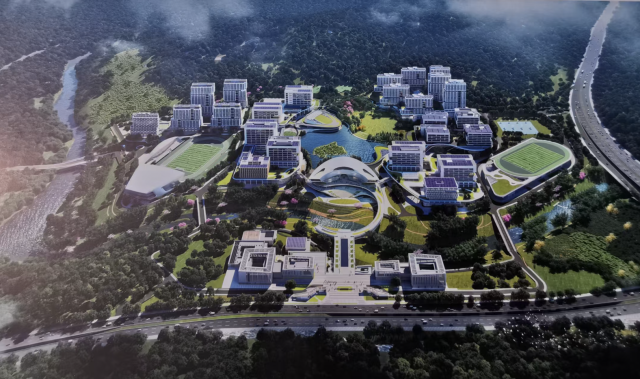
Nestled among mountains and bamboo groves in the Shenshan Special Cooperation Zone, the Shenshan campus of Shenzhen Polytechnic University is rapidly taking shape. Planned to accommodate 15,000 students, it is currently the Zone’s largest education infrastructure project under construction.
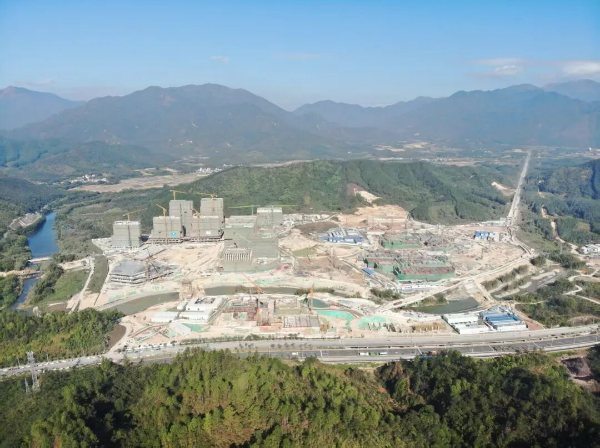
Machines roar, crane arms swing, and workers move busily among staggered buildings. Even with the Spring Festival approaching, the site shows no sign of slowing down. “We’ll keep working until Xiao Nian and expect to resume construction around the tenth day of the first lunar month,” the project manager said in a strong voice. Behind him stood the 12 buildings in the project’s first phase, all of which have already topped out. Major facilities, including the administrative and academic buildings and the gymnasium, are now entering façade installation and interior finishing stages.
Higherpay and paid travelhome
As Xiao Nian approaches, hundreds of workers remain on site. Asked about how to keep the team intact, the project manager laughed: “We have our ways—higher pay and paid travel home.” Workers handling finishing and electromechanical tasks are earning nearly three times their usual wages. The main construction contractor has also purchased return tickets in advance or arranged chartered vehicles and ride-hailing services for workers heading home. “If regular seats aren’t available, we’ll book first-class seats,” he said. “What matters most is making sure everyone gets home for the Spring Festival without worry.”
The project manager was equally confident about resuming work after the holiday. “We’ve divided the workforce into two groups. Some will return around the tenth day of the first lunar month, so we can make full use of the prime construction window before the rainy season.” His phone is filled with contact information of each team leader, allowing him to know exactly who will return and when.
Lego-like construction with robotic concrete vibration
“Look at the exterior walls, windows, and floor slabs—all are prefabricated in local factories and assembled here like building blocks,” the project manager said while introducing the dormitory buildings under construction. This technology improves quality, shortens timelines, and reduces on-site construction waste.
Even smarter, in the later-phase development zone, the project team is testing a modular building system. Dormitory modules are fully completed in factories—even toilets are installed—and then transported to the site for rapid assembly, much like an industrial production line.
This is how the project is pioneering new approaches to modular construction. Using standardized dormitory units as the basic building blocks, the project integrates architectural functions, structural components, electromechanical piping, and interior and exterior finishes into a cohesive design. With parallel factory prefabrication and on-site construction, on-site labor is reduced by 70% and the construction period is shortened by more than 50%, greatly streamlining procedures and improving coordination efficiency.
“The team plans to build a total of 2,162 ‘boxes’, one for each dorm room. At present, China Construction Science & Technology is producing prototype units. The assembly and concrete casting have been completed, and mechanical and electrical finishing works are underway. Mass production is expected in June.”
In addition, a concrete vibrating robot is under development and testing. It will replace manual labor in narrow, densely reinforced spaces, addressing construction challenges. “We expect it to be put into use two to three months after the Spring Festival.”
A “green campus” among mountains and waters
The project is not only about speed, but also about quality. Guided by green development principles, the campus connects surrounding mountains and waters through green belts, forming a continuous ecological corridor. The green coverage is expected to reach 35%. Multiple facilities are designed according to China’s three-star green building standard, aiming to create a low-carbon campus in harmony with nature.
The first phase is expected to be fully completed by July this year, welcoming its first students in September. The second phase is also progressing steadily and is expected to be fully operational in 2027.
Host: Party and Government Office of Shenshan Special Cooperation Zone
Technical Support Unit: Shenshan Special Cooperation Zone Smart City Construction Management Service Center
copyright © Shenshan Special Cooperation Zone All rights reserved