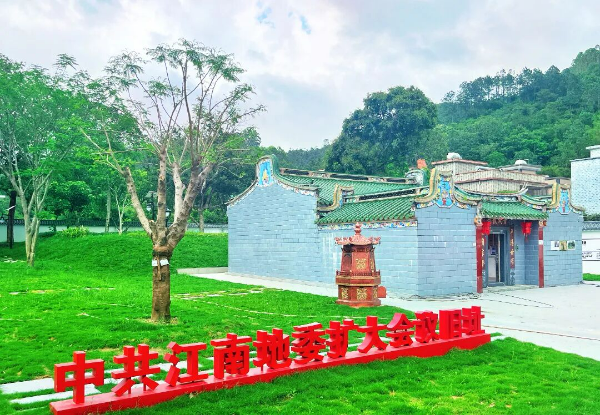
After extensive and meticulous preparation, Phase I of the Da’an Red Culture Park in the Shenshan Special Cooperation Zone has recently begun trial operations. Covering approximately 4,500 square meters, the first phase comprises a red memory museum, training classrooms, and auditoriums. Dedicated to preserving revolutionary history and heritage, the park integrates 19 surrounding revolutionary sites and has restored key landmarks, including the former venue of the Enlarged Meeting of the CPC Jiangnan Prefectural Committee.
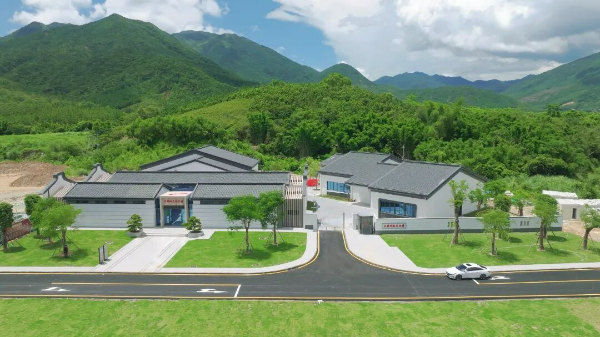
“Since the start of trial operations, the Da’an Red Culture Park has become a popular destination for training programs for Party officials and themed study activities on revolutionary history, receiving over 200 visitors per weekday,” said a park staff member. The park has hosted a range of guided tours and educational programs, including refresher training courses organized by Party schools, as well as selected training courses. These activities have been widely praised by participants, who noted that the advanced exhibition halls and facilities have transformed red culture from static text into a vivid and living legacy.
The Da’an Red Memory Museum, themed on “Red Heritage and Enduring Da’an,” integrates cultural relic reproductions, historical scene recreation, and digital technologies. Through six thematic chapters, it presents both the epic revolutionary history of the Da’an Dong area and its modern development, using immersive experiences to revive red memories and showcase the preservation and evolution of the red spirit in Da’an.
The museum incorporates a range of modern technologies to create immersive experiences. An intelligent central control system allows one-touch operation across the entire venue, with lighting automatically dimmed during screenings. Laser holographic projection blends historical scenes with real-world settings, while a LiDAR-enabled interactive wall transforms Shenshan’s development journey into a touchable timeline, allowing visitors to explore key milestones with a simple tap, thereby enhancing their sense of engagement. In the concluding hall, nano holographic film imaging turns glass surfaces into a three-dimensional stage, vividly presenting Shenshan’s blueprint for industrial development.
Since the beginning of its trial operations, the Da’an Red Culture Park has assumed the mission of building a leading red culture and tourism destination rooted in Shenshan and serving the Guangdong-Hong Kong-Macao Greater Bay Area, marking the start of an innovative journey in red cultural tourism.
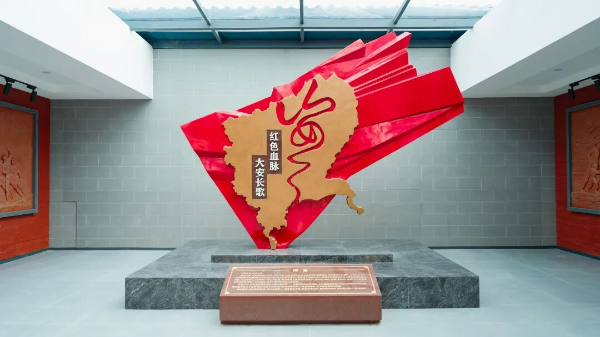
To achieve this goal, the park adopts an operational model that prioritizes Party school training, supplemented by visits and study tours. By innovatively integrating red resources and enabling the live transmission of history, it has developed themed routes that combine education on commitment to the Party, commemorative visits, in-depth study tours, and leisure tourism. Through ongoing improvements to its functions and facilities, the park is capable of hosting a wide range of activities, including Party official education and training, themed Party-building programs, and youth study tour and practice initiatives, gradually forming an education system that integrates classroom learning with on-site experience.
In the years to come, the Da’an Red Culture Park will introduce more innovative components, including expanding its youth guide initiative, producing oral history documentaries, and developing red-themed cultural and creative products, to offer more diverse and multi-layered experiences. According to an official from the Zone’s Organization and Personnel Bureau, the goal is for each visitor to transform from merely an audience member into an active narrator of the red history and a promoter of the red spirit.
As an integral part of Shenshan’s “Hundred, Thousand, and Ten Thousand Project” for rural revitalization, the Da’an Red Culture Park is more than an education base—it is a hub for integrated culture and tourism development. Linked with distinctive agricultural, cultural, and tourism initiatives, it creates an integrated ecosystem that combines study tours, cultural creativity, and leisure tourism. After learning about revolutionary stories, visitors can stroll along ecological trails and enjoy local cuisine.
Host: Party and Government Office of Shenshan Special Cooperation Zone
Technical Support Unit: Shenshan Special Cooperation Zone Smart City Construction Management Service Center
copyright © Shenshan Special Cooperation Zone All rights reserved